Category Archives: Social Media

Free Boaty

This is one of the funniest stories I’ve come across in a while. Brilliant stuff. Very British.

The online campaign to name this Royal Research vessel continues with James Hand’s suggestion of ‘Boaty McBoatface’ way out in front to name the  £200 million ship.

Hand found the list of possible names “really, really funny”.

“Clifford the Big Red Boat was my favourite. So I thought I’d throw one into the ring to see what happens. It got a few likes and I thought nothing of it,” Hand told the BBC.

It’s caused quite the internet storm, crashing the research council’s website and trending worldwide on Twitter and other social media with the hashtag #BoatyMcBoatface.

Personally I love Boaty, though Clifford the Big Red Boat is also a cracker.

I’ve added a few touches to the boat in this image. Pixar would be proud to have this boat on their screens.

What do you think? What should the boffins at the Natural Environment Research Council name their ship?

More: https://au.news.yahoo.com/a/31163879/man-responsible-for-boaty-mcboatface-sensation-stands-by-his-ship-naming-efforts/

social media mistakes

Some Common Social Media Mistakes

Despite many claims there are only a few real social media ninjas out there. While many businesses and individuals are doing it pretty well, there’s always room for improvement. However, there are some basic errors that too may accounts still make. Don’t get caught out making these obvious errors in your social media management.

Poor profile
We’ve all visited a page or profile and not been really sure if it’s the place we’re looking for or relevant at all to our needs. Make it obvious what you’re about and if you’re a business provide relevant contact information and a summary of exactly what you do or the products you are offering. If you don’t it could be costing you dollars.
Make sure you fill out your profile information in full and provide information people want about you. Don’t leave them in the dark and create a bad first impression. They will go elsewhere quick smart.

Buying followers
Avoid the temptation to buy followers. While it may sound tempting to buy a thousand new fans for ten bucks the reality is that they are largely fake accounts and won’t engage with your content.
Authentic engaging content is the holy grail and this will bring real fans who want to follow you for a reason. It’s the old tale of the hare and the tortoise as far as building a real following is concerned.

Not monitoring conversations
There’s no point building up a broad following if you’re not going to listen and take notice of what people are saying about you. You can gain valuable insight and feedback about your business from what people are saying about you – warts and all.
If you’re not paying attention you will miss out. If you’re attentive and prepared to interact you will be seen as authentic, caring and open for business.
There are many free and paid tools out there that can help you monitor and track conversations and sentiment. Meltwater, Hootsuite and Sprout Social are some of the better ones. Otherwise, just look and listen each and every day.

Call to action (CTA)
If you are wanting a visitor to do something; buy, refer, ask something, then you need to entice them to do just that and provide the way to do it.
Make sure you provide the link and let the person know what they’re being lead to – ‘Click here to to take control of your financial future now.’
Having no CTA just leaves them hanging and ultimately frustrated and unfulfilled. You’ve done the hard work in getting them there; don’t forget to close the deal.

Poor scheduling
You want to make sure that your audience is seeing your content. You need to understand them and their online habits amongst other key demographic information. Give your posts the best possible chance of being seen. Don’t post when your audience is less likely to be there.
It can be a bit hit and miss sometimes, but you can build up an understanding of the best times to post. Monitor your engagement and reach by day of the week and time and start looking for any patterns. Most good social media tools will feature a scheduling function to help schedule pre-prepared content to post at times you desire.

buzz aldrin

How Moon Boots and Buzz Launched General Electric on Snapchat

moon boots

The Missions moon boots from GE

Ever an innovator, General Electric (GE), one of the world’s largest conglomerates, has made a splash on social media platform Snapchat by releasing a version of the famous moon boots worn by Apollo 11 astronauts in 1969.

The just completed campaign celebrated GE’s contributions to the NASA Moon Mission 45 years ago. GE supplied advanced materials used in moon boots and the helmet visors worn by astronauts Buzz Aldrin, Neil Armstrong and Michael Collins.

The company made only 100 pairs of the 2015 boots and priced them at $196.90 (in homage to the year 1969). They were made available through online retailer JackThreads.com and sold out quickly.

GE decided to unveil and heavily promote the boots on Snapchat as it made it debut on the platform. Sam Olstein global director-innovation at GE said that the nature of Snapchat, fitting into the world of erasable media – media that goes away after a period of time, lent itself to storytelling and driving engagement and action. The Snapchat campaign featured photos, videos and stories about The Missions moon boots as they were named.

They even had Buzz Aldrin take over the Snapchat account for a day and talk about his trip to the moon and back. GE also used other social media platforms including Facebook and Twitter to drive Snapchat activity.

buzz aldrin

Buzz Aldrin shows off The Missions moon boots by General Electric

Olstein’s goal is to introduce the venerable GE brand onto new platforms and to new audiences. The company has been shedding its image purely as a maker of industrial products, light bulbs and refrigerators as it embraces the Internet age.

“We need to change the way the younger generation identifies with us as a company,” Olstein said.

“We’re transforming the company to be more of a software brand.

“This is the future of GE: the digitisation of industry. We’re taking all of our incredible complex machinery and mashing it up with software and sensors and evolving into more of a high tech industrial company.”

Olstein’s mission also includes – as he describes – using commerce as content.

“We see the role of product in a completely different way – around really using commerce as story telling,” he said.

Sam Olstein, Director of Global Innovation at GE, spoke at Interactive Minds Digital Summit 2015 in Brisbane.

Images – GE and NASA

Instant articles

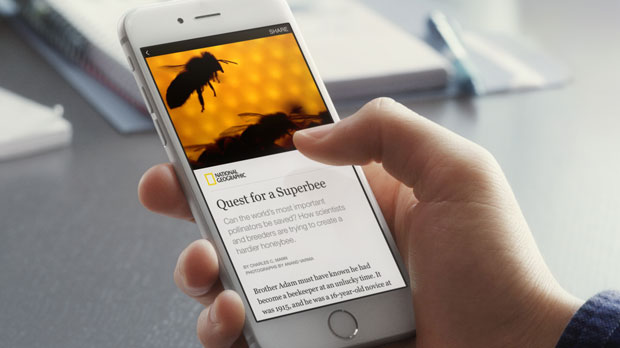
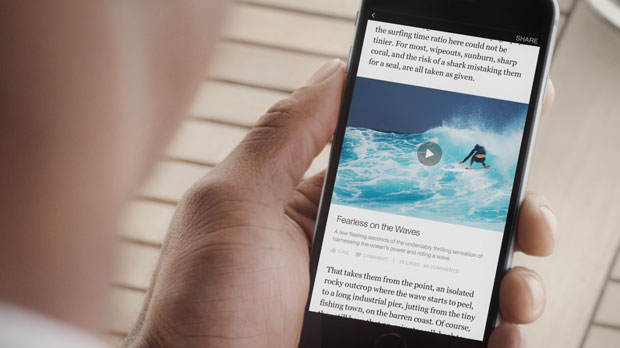
Facebook Launches Instant Articles For Publishers

In what has been described as good news for Web publishers and readers Facebook has introduced a new feature to its platform that allows publishers to publish their content direct to Facebook.

Facebook says… Along with a faster experience, Instant Articles introduces a suite of interactive features that allow publishers to bring their stories to life in new ways. Zoom in and explore high-resolution photos by tilting your phone. Watch auto-play videos come alive as you scroll through stories. Explore interactive maps, listen to audio captions, and even like and comment on individual parts of an article in-line.

“Fundamentally, this is a tool that enables publishers to provide a better experience for their readers on Facebook,” said Facebook Chief Product Officer Chris Cox. “Instant Articles lets them deliver fast, interactive articles while maintaining control of their content and business models.”

Many would agree that articles sourced from many news sites take too long to load on Facebook’s mobile platform in particular – about 8 seconds on average, which is an eternity. Many of us source our daily news updates and add to our required reading lists directly from sites like Facebook and Twitter.

Some worry about Facebook’s growing power over how journalism is distributed and seen. In making concessions, Facebook has allowed clicks and shares on Facebook to count towards the publisher’s site traffic despite Instant Articles keeping readers within Facebook. Facebook is also letting publishers keep 100 percent of the revenue when they sell ads themselves on Instant Articles and giving them data on their readers. If they can’t sell the ad space themselves then they will get 70% of the revenue if Facebook sells it instead – still an attractive proposition for many.

Twitter in particular will be concerned with these developments as Facebook continues to dwarf it in terms of users; 1.4 billion compared to over 300 million for Twitter. Twitter’s real-time nature has made it a trusted source of breaking news and interaction.

Facebook is working with nine launch partners for Instant Articles: The New York Times, National Geographic, BuzzFeed, NBC, The Atlantic, The Guardian, BBC News, Spiegel and Bild.

One major question being asked by media executives is whether Facebook can help publishers generate revenue from their mobile audiences more successfully than they can themselves?

I wouldn’t be betting against Facebook.

4-Video-a

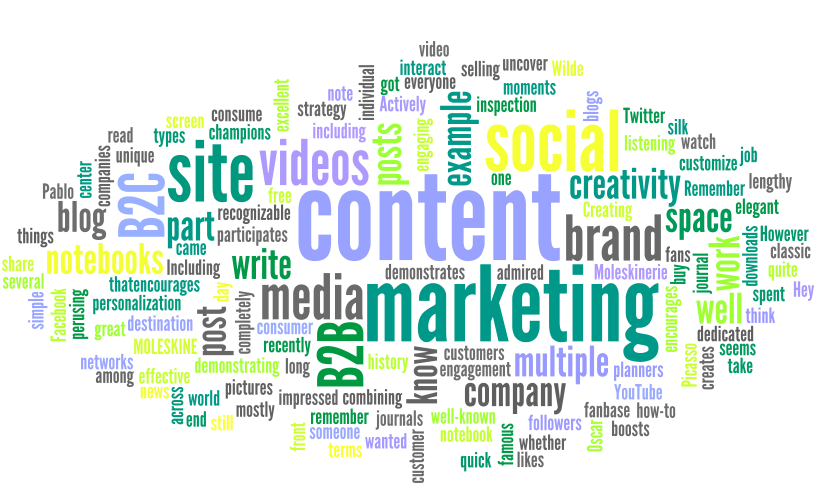
Creating compelling content that works with SEO

Content marketingContent marketing has emerged as a way for marketers to attract links through publishing compelling content. This overview provided by Copyblogger serves as a platform for successful content creation working in tandem with search engine optimisation.

Many of the determinants of the ranking position of a particular page are determined by factors not relating to the words on the page, though the location and frequency of keywords is still important.

If your content isn’t good enough to attract good, natural links and social sharing, it doesn’t matter how optimised the words on the page are, you will be missing out on traffic and possibly some key customers.

People are drawn to interesting content that is relevant, timely, educational and provides benefits to the reader. In short, it tunes in to the needs and desires of others.

The kind of SEO that content marketers are authoring are revolved around:
• Creating high-value content that achieves business objectives as if search engines didn’t exist.
• Using the power of social media to gain exposure for that content, which results in natural links and other signals of quality and relevance.
• Focusing on enhancing the natural authority of websites, pages, and individual writers, which creates industry influence and trust with Google.

Smart on-page optimisation (SEO copywriting) utilises the language the audience uses when searching and socialising, so Google sees you as the most relevant option.

Smart content marketers derive benefit from audience-focused content and by social media exposure and sharing.

Search engines need to be spoon-fed. Effective SEO copywriting tells Google which words are the most relevant ones to the people you want to reach.

You do need to begin with the ending in mind from a keyword standpoint.

Here’s a 5 Step guide to creating cornerstone content and getting it to rank well in search engines.

Key words
Choose the most appropriate keyword phrase for your content i.e. what is the most relevant question that searchers are asking that your content and business solution answer?
Then you have to make sure that your content is actually about that keyword or combination of keywords.

Title Tag and Headline
Using your targeted keyword phrase in your title tag is important but remember it is a headline and needs to read and entice as such. A compelling headline will also increase the chances of someone linking back to your title and in the process being friendlier for search engine algorithms.

Content
A well-worded and constructed article can rank highly by itself for search but particularly for a newer website you’ll need links from other authoritative sources.

The goal for content should be to answer the question for the reader so much better and more authoritatively than competitive sources. If so, then your content will be so much more worthy of linking to and improve your search results.

Content Landing Page
Having a well-constructed content landing page aids the reader in the usability of your site. The page should immediately communicate to the visitor what’s going on and provide useful links for them to navigate – much like a table of contents.

Some of the key benefits include: Retention; Bookmarking and Sharing; Linking to you; and Optimisation.

Related Content
Don’t go overboard, but do provide context when discussing advanced topics that require an understanding of the basics. Don’t assume that everyone is aware of your cornerstone resource or understands the basics. Periodically linking to your key content lets it find new readers — and fresh links.

Next time we’ll look at the benefits of creating cornerstone content and how to get readers to take the action you want.

Social Media: Are you listening?

ListeningSo you’ve gone to the trouble and expense of setting up your social media platforms and engaging in a content marketing program to share topical content you believe will be of interest.

But what do your customers really think of you?

For some time now we’ve seen and heard of examples of individuals causing quite a storm with seemingly localised complaints or comments which have caught fire and resonated far and wide.

But it’s important to note that many customers may not say exactly what they feel directly to you or on your page; their criticism may be on an anonymous page or competitor profile. Put simply, you need to expand your efforts in just looking in the obvious places for feedback.

Social listening is the art of listening in to conversations taking place and being willing to engage or join in the conversations.

There are several good social listening and monitoring platforms available including from iSentia, Meltwater and Hootsuite. These platforms set up correctly can give you an accurate and real-time indication of the sentiment being displayed towards you and your brand, and identify the key influencers and sceptics. Conversations can be monitored by channel and interacted with in the appropriate way and priorities identified. Social factors are also very important in ranking algorithms for search.

With the right tools you can listen in multiple languages, geo-locate your searches to be where your audience is, use conversation maps to monitor emerging trends and keywords, filter out unwanted noise, and quickly identify key influencers.

Successful social companies are already contacting disgruntled customers with a possible solution before they have the opportunity to become militant. Airlines, like Qantas and Virgin, are becoming adept at this and addressing many issues at the point of frustration and in real time. Needless to say I find it often easier and quicker to get a Twitter response from Telstra these days than trying the call centre.

glad-wrap_300Glad Australia recently had no choice to but to listen with a wave of backlash over their ill-considered decision to change the cutter on their cling wrap product. Instead of tearing in a downward motion, like we’ve done for decades, Glad decided to change the cutter to the top of the box thereby forcing users to pull up. It just didn’t make sense and infuriated many including yours truly. A back-flip has ensued and common-sense prevailed with Glad soon reverting to the original design.

Phew! Thanks for listening.

By Brenton Gibbs